What to see in Fuerteventura: the towns, the beaches and the wind
Updated October 14, 2026 · 9 min read
Five places make this island: the shifting dunes near Corralejo, the uninhabited Isla de Lobos, the beach at Cofete behind the Jandía ridge, the sea caves of Ajuy, and the old capital Betancuria up in the hills. If you want to see as much of that as possible in one day, take the Panoramic Tour for €65: eight hours covering Sotavento, Ajuy, Canarian villages and the dunes of Corralejo, 4.7 stars from 583 reviews. If you would rather see a single place properly, take the ferry to Lobos for €17 and stay there for as long as the time slot allows.
See availability and prices for the Panoramic Tour
An old island with not much left of it
Fuerteventura is the oldest island in the archipelago. The volcanic activity that built it goes back some 20 million years, and the sea has been wearing it down ever since. What you see today is the remainder: rounded bare ridges, wide valley plains, lava fields crumbling into rubble. The island’s highest point, Pico de la Zarza on the Jandía peninsula, reaches 807 metres. On Tenerife the forest is only just starting at that altitude.
The other numbers explain the rest. 1,660 square kilometres, just under 100 kilometres from the northern tip to Punta de Jandía in the south-west, around 30 kilometres at its widest – and only about five at the Istmo de la Pared, where Jandía hangs off the rest of the island. Of 325 kilometres of coast, around 55 are fine sand. That is the reason anyone comes here at all.
What the island is not
It is not green. There is no forest, there are no streams, there is no cloud belt of the sort you find on La Gomera or in northern Tenerife. Palms grow where someone planted them and waters them. Between February and April, after rain, a thin green film can lie over the slopes for a few weeks; the rest of the year the island is brown, ochre and black. If you equate landscape with vegetation, you will be unhappy here.
Nor are there lively old towns. Betancuria, founded in 1404 as the first capital and deliberately placed inland in the mountains so that pirates could not see it, has about two hundred inhabitants today. The church of Santa María dates back to 1410, was destroyed in a raid in 1593 and rebuilt in a mixture of styles. It is worth seeing, but it is half a morning, not a city break. Puerto del Rosario, today’s capital with a good 34,000 inhabitants in the town itself, is a port and administrative town and has no ambition to be a resort.
And it is almost never still.
The wind here is not weather, it is the defining feature
The trade wind blows across the Canaries from the north-east, and Fuerteventura is too flat to catch it. On the high islands the air banks up against the mountains and creates lee sides where it really is calm. Those mountains do not exist here. July is the windiest month, averaging around 27 kilometres per hour, and April to August is one long windy season.
That cuts both ways, and both belong in your planning. On one side, it makes the island one of the most reliable watersports areas in Europe: surf lessons start at €50, while windsurfing and kitesurfing sits well above that with a median of €130, because those are usually multi-day courses with equipment included. At Playa de Sotavento south of Costa Calma the sea withdraws for several kilometres at low tide and leaves a shallow lagoon behind a sandbar; the World Cup is held at Risco del Paso in summer.
On the other side it means that a towel on an open beach with no shelter is not a relaxed afternoon in July. Sand flies, your book flies, and the wind cools you so effectively that you only notice the sunburn in the evening. If you want to lie somewhere sheltered, look for the bays – the lagoons at El Cotillo, the man-made bay at Caleta de Fuste, the town beach at Morro Jable. With very young children the wind shifts the shape of the whole day so much that it is a subject in its own right: Fuerteventura with a baby.
The north: Corralejo, the dunes and Lobos
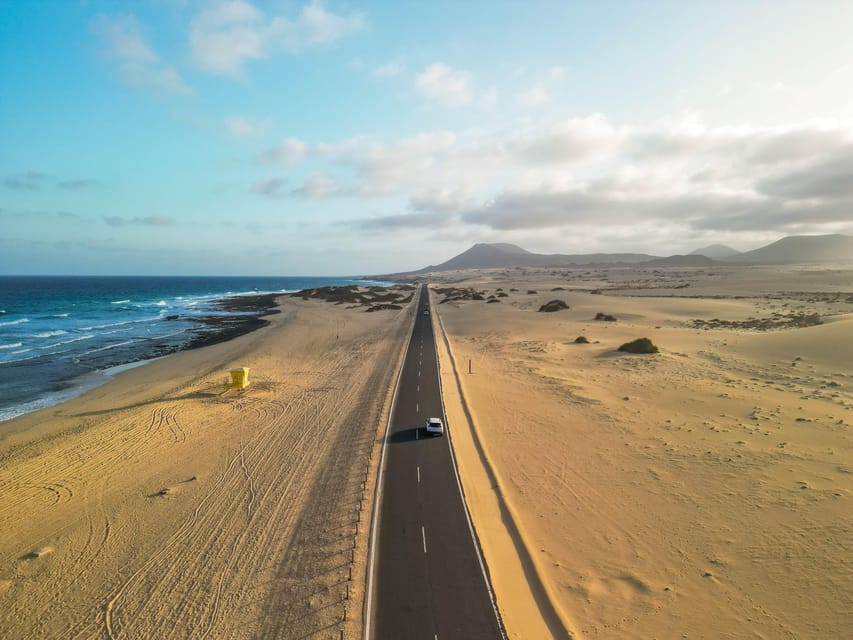
Corralejo sits on the northern tip. The natural park with its shifting dunes begins immediately to the south, 2,668 hectares running a good ten kilometres along the east coast. The sand is pale, the water turquoise, and because there is no wall of hotels behind the beach it looks like the brochure. The current and the waves along this stretch need to be taken seriously, though, and the dunes are a protected area, not buggy terrain.
Offshore lies Isla de Lobos: uninhabited, flat, one restaurant and one volcanic cone. The crossing from Corralejo takes around 15 minutes by speedboat and costs €16 to €17 return. Visiting requires a free permit from the Cabildo de Fuerteventura, because the natural park is capped at 200 visitors at any one time, in two slots from 10am to 2pm and from 2pm to 6pm. Some operators apply for it on your behalf, others do not. That is the one question you genuinely have to ask before booking, and the arrangement can change. With 22 offers and 11,501 reviews, Isla de Lobos is the most reviewed block on the water.
See dates for the ferry to Lobos Island
Around 20 road kilometres west, on the FV-109 to Lajares and then the FV-10, about 20 minutes away, lies El Cotillo, a fishing village with no hotel blocks. North of the village, reefs form a series of shallow lagoons where hardly any swell arrives; behind them stands the three-towered Faro de Tostón. Inland at Lajares a signposted path leads up to the crater rim of Calderón Hondo, a good five kilometres there and back. The last eruptions were thousands of years ago. Fuerteventura has been a UNESCO Biosphere Reserve since 2009 and a recognised Starlight Reserve since 2015; the guided stargazing tour at Calderón Hondo costs €45 and holds 4.8 stars from 971 reviews.
The south: Morro Jable, Jandía, Cofete
Morro Jable is the southernmost resort, a good 100 road kilometres and around an hour and a half from Corralejo. The whale and dolphin boats leave from its harbour: the two-hour trip with drinks and a swim stop costs €49 and, with 5,248 reviews, is the most reviewed tour on the island – at 4.2 stars, jointly with one buggy tour the weakest rating in the top 20. Wild animals are not a performance, and anyone expecting a guarantee will be disappointed. The whole whale and dolphin watching category starts at €40. Whether a trip like that suits children depends on the type of boat rather than the price: boat trips with kids.
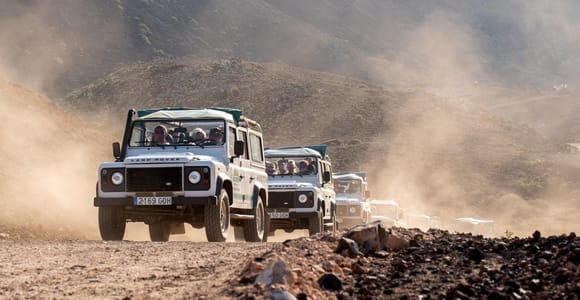
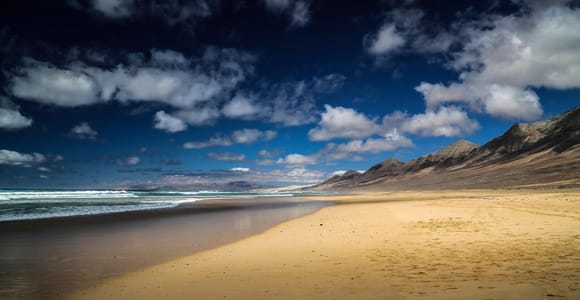
Behind the ridge, on the Atlantic side of Jandía, lies Cofete: twelve kilometres of beach, a dozen houses, nothing else. It is the most striking place on the island and the one where you should not swim; the current and the shore break are strong there and there is no supervision. The access road from Morro Jable is a winding gravel track over the ridge. Most car hire contracts exclude unpaved roads from cover, which in practice means you pay for every stone chip yourself; what applies in your case is in your contract. That is why most people get there with a guided tour instead: the Cofete beach jeep safari costs €65 for three hours and holds 4.5 stars from 2,578 reviews; further off-road trips come under buggy and quad, from €60. The version including Villa Winter costs €57 for four hours and comes under things to do.
See dates for the Cofete beach jeep safari
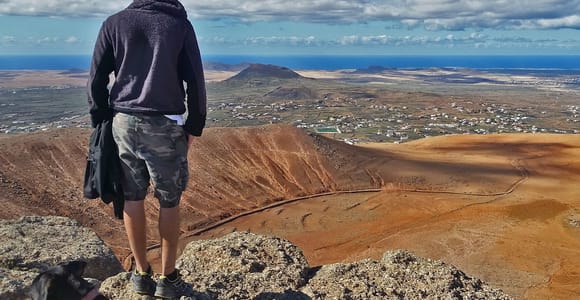
If you want to walk, head up Pico de la Zarza from Morro Jable. The path has no shade and the summit is often in cloud, but the view drops straight down onto Cofete. It is no place for children under five, and there are other routes for them: Fuerteventura with a toddler.
The centre and the west coast
Caleta de Fuste lies on the east coast, around seven kilometres south of the airport. The resort was drawn on a plan and has correspondingly little life of its own, but it does have a sheltered man-made bay with a shallow entry and short distances. For a first stay on the island, or with small children, that makes it a very sensible base, see Fuerteventura with kids.
The west coast is best seen at Ajuy. From the black pebble beach Playa de los Muertos a paved path leads along the cliffs in barely a quarter of an hour to the Cuevas de Ajuy, sea caves washed out of the island’s oldest rock, more than 100 million years old and thus considerably older than Fuerteventura itself. Betancuria, Ajuy and a viewpoint over the interior are the core of almost every island tour.
Five ways to see the sights compared
| Tour | Duration | from | Rating | suits |
|---|---|---|---|---|
| Panoramic Tour | 8 hours | €65 | 4.7 ★ · 583 | first-time visitors who want to see as much as possible |
| Lobos Island ferry from Corralejo | at your own pace | €17 | 4.7 ★ · 3,521 | solo travellers and budget-minded families |
| Cofete beach jeep safari | 3 hours | €65 | 4.5 ★ · 2,578 | anyone who wants just the one place beyond the ridge |
| Tour to the most iconic places with up to eight people | 6 hours | €79 | 4.8 ★ · 180 | couples who don’t want a full coach |
| Top 5 Instagram Spots tour | 8 hours | €99.19 | 4.9 ★ · 246 | anyone who wants to photograph lagoons, caves and volcanoes |
The Panoramic Tour for €65 is the classic round trip: Sotavento, Ajuy, villages, dunes, eight hours. The tour to the most iconic places for €79 does the same in six hours with a maximum of eight passengers and runs from the north through the west to Jandía. And the Top 5 Instagram Spots tour for €99.19 is the most expensive and the best rated of the three – it looks for lagoons, caves and volcanoes rather than towns.
See dates for the tour to the most iconic places
What you can book locally
181 offers are bookable from €12.50, with a median of €70 and 56,055 reviews between them. Most of it happens on land: 80 offers under things to do, from goat’s cheese workshops to stargazing and Oasis Wildlife near La Lajita, whose entry ticket costs €41.50 and which, with 3,699 reviews, is the most reviewed item on land.
On the water there are 25 snorkelling and diving offers from €27 and 15 catamaran trips from €62, median €79. The windsurfing and kitesurfing courses come with a strikingly small figure: 13 offers, but only 77 reviews. That does not mean the courses are poor, it means almost everyone books them at the school on the spot rather than in advance. You should not lean on so few voices when comparing.
And then there is the neighbouring island. Lanzarote is a short ferry ride away, and the day trip to Timanfaya is the only island change that works as an excursion from here at all. What it costs, how long it takes, whether it is worth it, and which island suits you in the first place, is covered in the companion piece on the Canary Islands.
Our recommendation
For most people: the Panoramic Tour for €65. Eight hours, 4.7 stars from 583 reviews, and it takes in Sotavento, Ajuy, the villages and the dunes of Corralejo – exactly the places this article is about. On a first visit it replaces three days of car hire. Not for families with small children – eight hours in a vehicle is too long for them.
On a small budget: the ferry to Isla de Lobos for €17. 4.7 stars from 3,521 reviews, you decide the return time yourself, and €17 is the cheapest way to a place you won’t forget. Settle before booking who applies for the free permit.
For couples: the tour to the most iconic places for €79. Six hours instead of eight, a maximum of eight passengers, 4.8 stars from 180 reviews. Fourteen euros more for two hours less and a small group – worth it for anyone who avoids coaches.
If you want to photograph: the Top 5 Instagram Spots tour for €99.19. The best rating on the list, 4.9 stars from 246 reviews, eight hours to lagoons, caves and volcanoes. In return it skips Betancuria and the villages – this is a landscape tour, not an island primer.
Just Cofete and nothing else: the Cofete beach jeep safari for €65. Three hours, 4.5 stars from 2,578 reviews, and it drives the track your rental contract forbids. The shortest way to the most striking place on the island – but only to that one.