Fuerteventura with a baby: wind, shade and the length of the island
Updated October 14, 2026 · 6 min read

With a child under two, the short answer is: one place, one sheltered beach, mornings outside – and if there is one thing worth booking, it is Lobos by speedboat for €16. Fifteen minutes crossing, after which you set the pace of the day yourselves, and you can call it off. If you trust yourselves with two hours and no way off, the dolphin and whale watching trip from Morro Jable for €49 is half the time of a catamaran trip: two hours instead of four. Anything from four hours up is, at this age, paid for and not used. The holiday is decided by the afternoon, not by the excursion menu, anyway.
Check dates and prices for the Lobos speedboat
Fuerteventura is not a difficult destination with an infant, but it has three peculiarities you are better off knowing in advance: the wind, the missing shade and the length of the island.
Five excursions and what they mean with a baby
| Excursion | Duration | From | Rating | Best for |
|---|---|---|---|---|
| Lobos by speedboat | 15-minute crossing | €16 | 4.8 ★ · 1,973 | families who can be back within an hour |
| Dolphin and whale watching from Morro Jable | 2 hours | €49 | 4.2 ★ · 5,248 | parents who trust themselves with two hours and no way off |
| Jeep safari to Cofete beach | 3 hours | €65 | 4.5 ★ · 2,578 | adults taking turns, not the baby |
| Glass Bottom Boat Cruise with lunch | 4 hours | €75 | 4.4 ★ · 1,514 | older siblings, while one parent stays at the accommodation |
| Wild North and Corralejo tour from the south | 7 hours | €77 | 4.8 ★ · 1,076 | nobody with a child under two |
The right-hand column is the whole article in short: with an infant, what matters is not how good an excursion is but how quickly you can end it.
The wind here is not a weather situation, it is the normal state
The north-easterly trade wind blows almost all year round, and it comes from much the same direction with remarkable consistency. It is strongest between April and August, with July as the windiest month. From October to March, by contrast, there are regularly days with no wind at all. On top of that comes a daily rhythm: mornings are usually calm, and the wind picks up in the afternoon.
For adults, that is exactly why you do not sweat here at twenty-eight degrees. At ground level, things look different. Driven sand flies low, and low is also where the blanket with the baby on it lies. A beach day with an infant therefore shifts to the morning of its own accord, and the afternoon belongs to a nap back at the accommodation. Reverse that order and you will spend the whole holiday fighting it.
Which beaches are sheltered and which are not at all
Playa de la Concha near El Cotillo in the north-west is the one place where the wind becomes a side issue. Lava reefs frame a shallow lagoon, the water inside stays calm, and at low tide some of the pools hold only a few centimetres. You can walk fifty metres out and still be waist-deep. There is wind there too, it just barely reaches you in the sheltered pool.
Caleta de Fuste, in the middle of the island, is not a place that grew over time but one built around a horseshoe-shaped bathing bay. The beach shelves gently, and there are no waves and no strong currents. It is seven kilometres and under ten minutes’ drive from the airport, which on arrival day with an overtired baby is worth more than any view. The town has no charm. It does have short distances.
In Corralejo itself, Playa Waikiki, also called Galera Beach, is a large town beach in a sheltered position that you can reach on foot.
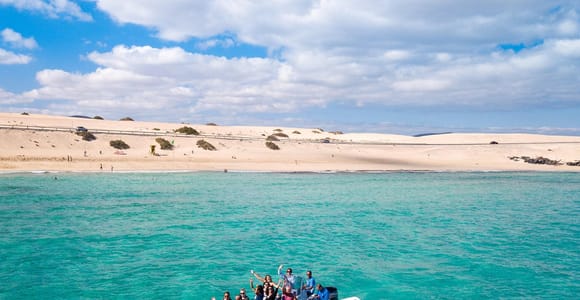
What is not sheltered are the Grandes Playas south of Corralejo: nine kilometres of open beach along the dune nature park, home to the largest dunes in the Canaries. This stretch owes its reputation to the wind, and the surfers and kitesurfers are there for precisely that reason. It is even clearer at Playa de Sotavento near Costa Calma, where the shape of the land accelerates the trade wind further and where the windsurfing and kitesurfing World Cup is held every year. A magnificent sight. Pointless with a pushchair.
The only shade is the shade you bring yourself
Fuerteventura is largely treeless. There is too little rain, the soils are poor, and the few naturally grown trees stand in damp valleys inland, not on the coast. Anything that casts shade by the water was put there by somebody: beach bars, umbrellas for hire, hotel complexes.
An ordinary beach umbrella rarely survives the afternoon wind. What works here is a beach shelter or a sun sail you can weigh down with sand or anchor properly. Everything beyond that – sun protection, fluids, heat – does not belong in a travel article but in a conversation with your paediatrician or with a pharmacy on the island.
The island is longer than the map makes it look
Corralejo lies in the north, Morro Jable right down in the south. Between them are about 110 kilometres on the FV-2 and a good hour and a half of driving time. There and back in one day is over three hours in a car seat, and with a baby that is the difference between an outing and a ruined day.
In practice that means one base for the whole holiday, not two. And be careful with the long things to do on land: the tour from the south into the wild north takes seven hours and costs €77, and it is designed for adults. The beach at Cofete is reached from Morro Jable via roughly nineteen kilometres of unsurfaced track, for which you should allow about an hour in each direction; the jeep safari out there starts at €65 for three hours. Both are things you postpone by a few years.
If you hire a car, book the infant carrier or child seat at the same time and have the operator confirm that it will actually be there.
What plainly does not work with a baby
This deserves to be written down rather than hinted at: a large part of what Fuerteventura is known for is completely off the table with a child under two.
Buggy and quad tours, of which there are 18 here, from €60 and with a median of €109, are open vehicles on dusty tracks, and a helmet is part of the kit. The jet ski from Morro Jable, €80 per group of up to two people for half an hour, is no different. Speedboats slam hard over the swell. Surf lessons from €50 and windsurfing courses assume that you get into the water yourself. None of this is a programme for an infant, and no wording turns it into one.
If you still want to do some of it, split the day: one goes, one stays. It is unromantic, but it works.
On minimum ages we deliberately give no figure here. Operators set different limits, and what applies is stated on the relevant booking page. For boats we have written the question up in more detail: from what age a boat trip makes sense. Whether an operator carries life jackets in baby sizes on board is something nobody can know from the outside. That is a question you ask before booking, not an assumption you make.
Lobos is fifteen minutes away. Still a question.
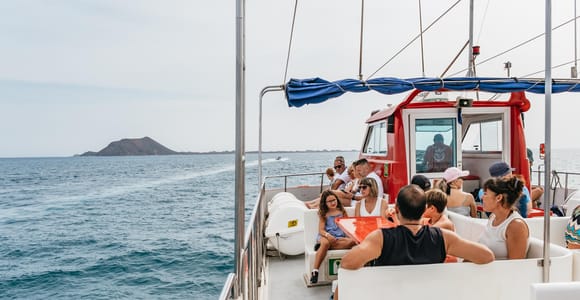
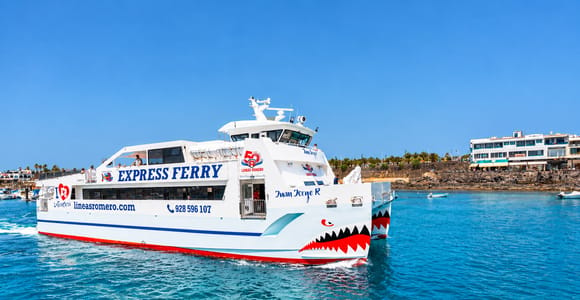
Around Isla de Lobos there are 22 offers from €16. The crossing from Corralejo takes about fifteen minutes, the speedboat ticket costs €16 and the ferry €17.
The crossing is not the problem. The time afterwards is. Lobos is a nature park, access has required a permit since 2019, the permit itself is free, the number of visitors per day is capped and split into time slots of roughly four hours each. Some tickets include the park entry, others do not; what applies to yours is stated on the booking page. Quotas and timetables change, so check them shortly before you travel.
Four hours on a shadeless island, with a fixed return time and no way to leave early on a whim: whether your child can take that is something you know better than any travel text. It remains a question.
Check availability for the dolphin and whale watching trip
When this trip is a bad idea
If the beach day is the only plan and the trip falls in high summer, it runs into the windiest weeks of the year. Then there is the calima: in summer, hot air from the Sahara can push the trade wind back, temperatures then climb past forty degrees in places and dust hangs in the air. You cannot plan around it, and you certainly cannot rebook around it.
And if you are booking so that the parents get to experience something too, it becomes difficult. What this island offers by way of excursions hangs on the wind, on a boat or on a dirt track, and that is precisely what is barred with an infant. Two years later the same list looks completely different, and that is where the options for a toddler between two and five begin.
What works well here is the unspectacular: one place, one sheltered beach, mornings outside, afternoons indoors. If you are bringing older siblings and want to know how a day can be spread across different age groups, you will find that in the overview for families.
Our recommendation
For most people with a child under two: Lobos by speedboat for €16. Fifteen minutes crossing, 4.8 stars from 1,973 reviews, and the rest of the day is yours. Two things to sort out beforehand: the free Lobos permit and the shade, of which there is almost none over there. If the baby stays by the landing stage, the excursion costs a fifth of a four-hour tour.
If you trust yourselves with two hours: the dolphin and whale watching trip from Morro Jable for €49. It is the ride with the most reviews on the island, 5,248 of them, and with 4.2 stars the weakest rating in this selection – dolphins cannot be ordered to appear. Two hours with no way off stay two hours with no way off.
If older siblings are coming and one of you stays behind with the baby: the Glass Bottom Boat Cruise with lunch for €75 or the jeep safari to Cofete beach for €65. Both are good excursions for adults and older children – and both last longer than an infant can comfortably manage on board or on a track.
What we would not book with a baby: the tour into the wild north at seven hours, the buggies on dusty tracks, the jet ski and the surf lessons. No amount of planning changes that; in two years the list looks different.