Which Canary Island suits you – and where does Fuerteventura fit?
Updated October 1, 2026 · 8 min read
In short: Fuerteventura is the island for beach, wind and open space, Lanzarote the one for volcanic landscape, Gran Canaria and Tenerife the ones for city and variety, La Palma and La Gomera the ones for mountains and green, El Hierro the one for seclusion. From Corralejo you can see Lanzarote lying across the water, and that answers the second question too: only this one island works as a day trip from Fuerteventura. The crossing takes 25 to 35 minutes, the Lanzarote/Fuerteventura ferry ticket costs €21 per person, you choose your own departure time, and it has 4.7 stars from 440 reviews. If you would rather take in Timanfaya on an organised trip, book the guided Lanzarote tour with lunch for €160 – 15 hours, in other words the whole day. Every other island in the archipelago sits far enough away that a visit rebuilds your holiday instead of adding to it.
If you are on Fuerteventura wondering whether to fit in a second island, what you are really deciding is one thing: how much of a day are you willing to give up?
Seven islands, and none of them replaces another
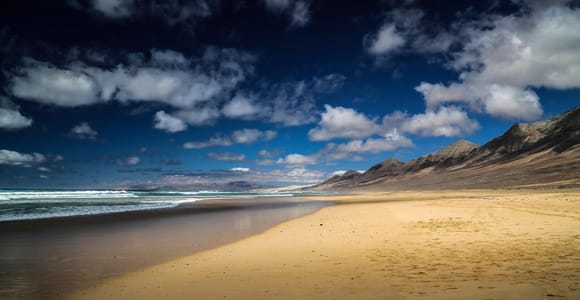
Fuerteventura is the flattest of the large islands, and almost everything else follows from that. Its highest point, Pico de la Zarza on the Jandía peninsula, measures 807 metres; the trade wind clouds pass at 1,200 to 1,400 metres. The island does not reach up into them, catches no moisture, and stays the driest in the archipelago. How it was formed and what is left of it today is in what to see in Fuerteventura.
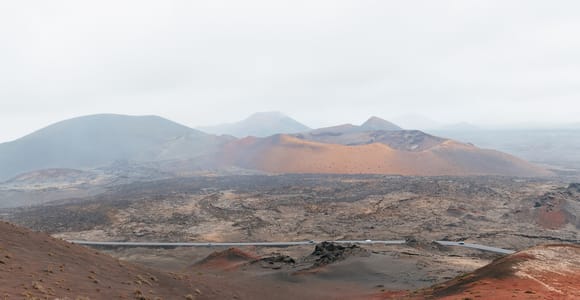
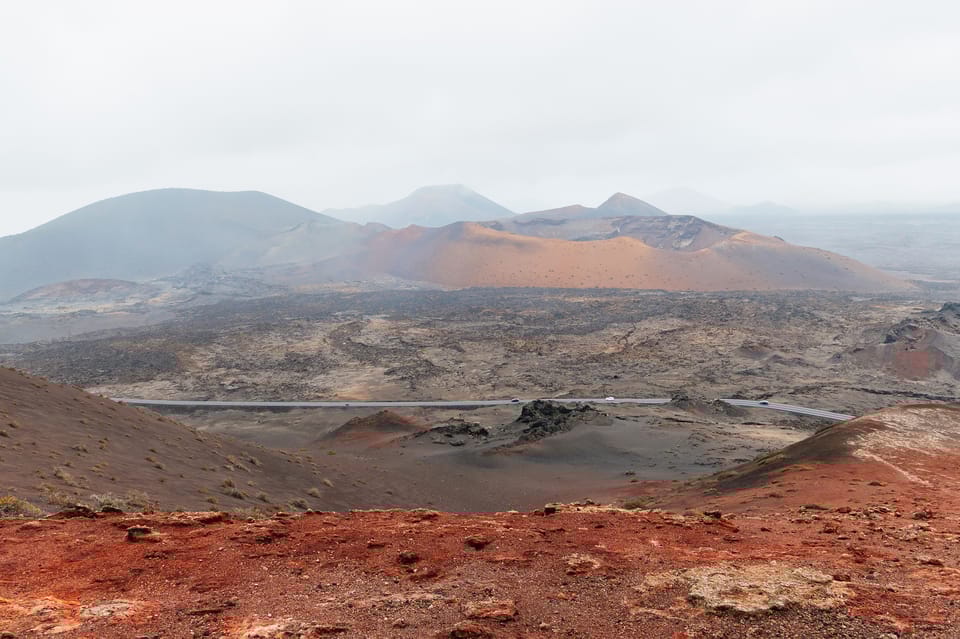
Lanzarote lies within sight from here and still has nothing in common with this island in terms of landscape. The lava fields date from the eruptions of 1730 to 1736 and of 1824, and Timanfaya is one of the four national parks of the Canaries. In the La Geria wine region each vine stands alone in a dug-out hollow, sheltered by a semicircular dry-stone wall against the wind. Once you have seen César Manrique’s signature style, you recognise it all over the island.
Gran Canaria is often called a continent in miniature, and for once that is not marketing copy. The dune field of Maspalomas, protected since 1987, lies at the southern tip; in the north sits Las Palmas with an old town, a harbour and a city beach. If you want something other than a seafront promenade in the evening, you will find it there.
Tenerife is the largest island and the one with the steepest gradient. Teide measures 3,715 metres and is the highest mountain in Spain; the north of the island is green and damp, the south dry. The strait between Tenerife and La Gomera holds a resident population of pilot whales and bottlenose dolphins, designated in 2021 as Europe’s first Whale Heritage Site.
La Palma is the steepest and greenest of the inhabited islands. The Caldera de Taburiente national park encloses a vast basin, and on the ridge above it stands one of the largest arrays of telescopes in the world. The Tajogaite eruption ran from 19 September to 13 December 2021 and changed the west of the island.
La Gomera carries the Garajonay laurel forest, a national park since 1981 and a World Heritage Site since 1986. It is the opposite of Fuerteventura: mist instead of sun, hairpin bends instead of straight track.
El Hierro is the smallest and youngest of the main islands, formed around 1.2 million years ago. It lives on diving at La Restinga, the southernmost settlement in Spain, and covers its electricity through the Gorona del Viento wind and water plant. People who go there are after seclusion, not a programme.
Then there is La Graciosa, officially the eighth Canary Island since June 2018. Boats run there from Lanzarote, not from here.
Who each island is the wrong choice for
This is the part the brochures leave out.
Fuerteventura is wrong if you want to hike. 807 metres is all the island has, and it is not green in any other respect either. There are good paths along crater rims and across Jandía, but anyone looking for altitude and shade belongs on La Palma, La Gomera or in the north of Tenerife, and will be disappointed here however fine the beach is.
Fuerteventura is also wrong if you want a city. Puerto del Rosario is not a night out; what the capital is instead is in what to see in Fuerteventura. Museums, an old quarter and evening life are on Gran Canaria and Tenerife.
Tenerife and Gran Canaria are wrong if you are looking for quiet, at least in their big southern resort belts. Both islands have still corners, but you have to go and find them. On Fuerteventura the emptiness is the default state: the second largest island in the archipelago by area, and only around 129,000 inhabitants.
La Palma and La Gomera are wrong if sun is the reason you are booking. The very height that makes them green also holds the cloud. That is not bad luck with the weather that year, it is the same trade wind that leaves Fuerteventura dry.
El Hierro and La Gomera are wrong with very small children. The routes inland are winding and long, and what a two-year-old gets out of them bears no relation to that. What does work for that age group is in Fuerteventura with a toddler and Fuerteventura with a baby.
Lanzarote is wrong if you want to learn to windsurf. The standing-depth shallows that beginners need are on this island, not over there; where exactly, and what gets raced there in summer, is in what to see in Fuerteventura. Courses are under windsurfing and kitesurfing, wave riding under surf lessons.
Fuerteventura is the wrong island if whales are the main reason. The resident population lives in the strait between Tenerife and La Gomera. From here you head out from Morro Jable, and that is a good boat trip, but not a promise that whales will turn up. The overview is under whale and dolphin watching.
What Fuerteventura has and what it lacks
The whole island is protected and is a recognised dark-sky reserve; a dark night sky here is a certified feature, then, not an advertising word. On top of that comes its own range of excursions, whose largest block revolves around Isla de Lobos off the northern tip.
What is missing is quickly listed: a national park, a laurel forest, a mountain above 807 metres, a large city, reliable green. If you count that as a drawback, you are right. If you take space, wind and empty beaches in exchange, you are also right. What there is to see on the island itself, and what the offers cost in detail – entry price, median, review counts, the split by category – is in what to see in Fuerteventura, and the land-based offer under things to do in Fuerteventura.
Island hopping from Fuerteventura: what actually works
Only one connection is any good as a day trip. Four operators run between Corralejo and Playa Blanca on Lanzarote: Baleària, Naviera Armas, Fred Olsen Express and Líneas Marítimas Romero. Depending on the vessel the crossing takes 25 to 35 minutes, and there are more than twenty departures a day all year round. Timetables and prices change, so check what applies on your day before you travel.
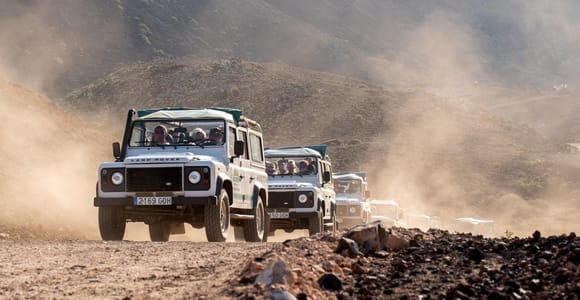
As a guided day trip, the Lanzarote tour with lunch is on GetYourGuide: €160 per person, 15 hours, 4.5 stars from 310 reviews. According to the booking page, it includes the ferry from Fuerteventura, a stop at a winery, lunch, Timanfaya National Park and the Jameos del Agua lava tunnel, admission included. There is a practical reason why an organised trip makes sense for Timanfaya: the interior of the park is covered on the Ruta de los Volcanes, a route of around 14 kilometres reserved for the park’s own coach.
See availability and prices for the guided Lanzarote tour
Three ways to Lanzarote compared
| Offer | Duration | From | Rating | best for |
|---|---|---|---|---|
| Lanzarote/Fuerteventura ferry ticket | crossing of 35 minutes | €21 | 4.7 ★ · 440 | families and couples who want to plan their own day |
| Ferry ticket with Wi-Fi, one-way or return | crossing of 30 minutes | €19.50 | 4.7 ★ · 271 | solo travellers on a small budget |
| Guided Lanzarote tour with lunch | 15 hours | €160 | 4.5 ★ · 310 | anyone who wants to see Timanfaya and Jameos del Agua without planning it themselves |
Gran Canaria is about two hours away by fast ferry from Morro Jable. Depending on route, operator and ship, the connection between the two islands runs anywhere from 2 hours to 6 hours 45 minutes. That is the difference between a long day and a lost one.
Tenerife means flying, roughly 45 to 50 minutes with Binter and into Tenerife North; there is a direct service to La Palma only in high summer: Binter runs it in 2026 from mid-July to early September with six flights a week, and for the rest of the year you have to connect. La Gomera and El Hierro always mean a connection, either via Gran Canaria or via Tenerife North. Going via Tenerife is easier than it sounds: the Binter flight from Fuerteventura lands at Tenerife North, and that is exactly where the onward services to La Palma, La Gomera and El Hierro leave from. No airport change is involved. Only people arriving from Europe at Tenerife South, where most holiday flights land, have that to deal with. Even so, none of those three works as a day trip from Fuerteventura.
When switching islands is not worth it
On a one-week stay the trip to Lanzarote costs one of your seven days, and all of it. If you are staying in the south, add the drive up to Corralejo, which is no quick hop on this island. How long a day spent crossing this island becomes is shown by the local offer itself: the tour “Wild north and Corralejo from the south” runs 7 hours without any boat being involved at all.
The weather is no reason to switch. Lanzarote is half an hour away and has the same sky; change island because of cloud and you take the cloud with you.
With small children it rarely adds up either. The guided tour takes 15 hours, and that is more than most families get through well in one day. What works instead is in Fuerteventura with kids, and everything about boats in boat trips with kids.
That leaves the price. The guided tour costs a family of four €640, the ferry €84. For the difference, you get several days of extra things to do here instead, such as the ferry to Lobos for all four plus a day out with a buggy or quad on top.
If you genuinely want to see two islands, split the stay and move accommodation. As an excursion only Lanzarote works, and even then only if you are willing to give the day over to it completely.
Our recommendation
For most people: the Lanzarote/Fuerteventura ferry ticket for €21. 4.7 stars from 440 reviews, a crossing of 35 minutes, and you set the departure time yourself – so the day stays in your hands rather than in a programme. Not for you if you want to go into the interior of Timanfaya: only the park’s own coach runs the Ruta de los Volcanes, and getting there on Lanzarote needs your own vehicle or a guided trip.
For a small budget: the ferry ticket with Wi-Fi for €19.50. 4.7 stars from 271 reviews, a crossing of 30 minutes, one-way or return. The cheapest way across – in exchange you plan the route, lunch and return entirely yourself.
If you want to see Timanfaya without planning it yourself: the guided Lanzarote tour with lunch for €160. Ferry, winery, lunch, national park and Jameos del Agua in one package, 4.5 stars from 310 reviews. In exchange it is 15 hours and €640 for four people – for families with small children, that is the wrong day.
If you cannot decide, stay put: a second island always costs a full holiday day. Anyone who would rather spend it here will find plenty for several days under things to do in Fuerteventura and in the decision guide Which tour is right for you?.