Fuerteventura without a car: what actually works and what does not
Updated October 14, 2026 · 10 min read
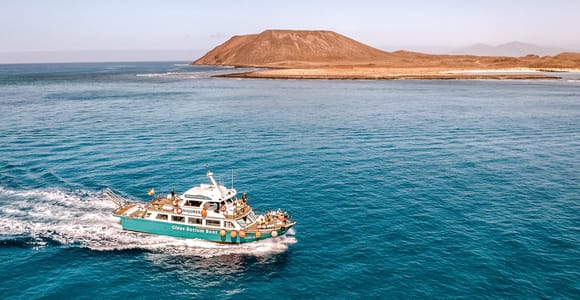
Without a hire car you get by well here, as long as your holiday consists of the beach, two or three booked excursions and the island of Lobos. The bus carries the north–south axis; the west coast it does not. The excursion that works best without a car of your own is the Lobos ferry from Corralejo for €17 — the boats leave right in the middle of town, so you need no transfer. Anyone staying in the south has the same thing on their doorstep with the dolphin and whale watching trip from Morro Jable for €49. Anything further away — Cofete, the north seen from the southern tip, Lanzarote — you add on as a guided tour with pick-up.
Five excursions that work without a car of your own
| Excursion | Duration | From | Rating | Best for |
|---|---|---|---|---|
| Lobos ferry from Corralejo | Return crossing | €17 | 4.7 ★ · 3,521 | anyone staying in Corralejo who wants to set their own schedule |
| Dolphin and whale watching from Morro Jable | 2 hours | €49 | 4.2 ★ · 5,248 | families in the south with a free morning |
| “Wild North and Corralejo” from the south | 7 hours | €77 | 4.8 ★ · 1,076 | anyone staying in Morro Jable or Costa Calma who wants to see the north |
| Jeep safari to Cofete beach | 3 hours | €65 | 4.5 ★ · 2,578 | anyone who wants to see Cofete without being tied to two bus departures |
| Lanzarote day trip with lunch | 15 hours | €160 | 4.5 ★ · 310 | anyone who wants to see the neighbouring island and can give up a whole day for it |
The bus network carries the north–south axis and not much else
There are 111 road kilometres between Corralejo and Morro Jable. A car covers them in roughly 1 hour 40. The bus, with a change along the way, takes about three and three quarter hours. That gap is the whole story, and it does not decide whether you can manage without a hire car — it decides which half of the island exists for you at all.
The island bus is called a guagua here and is run by Tiadhe. Along the main axis it works well. Line 10 runs from Puerto del Rosario via the airport, Caleta de Fuste, Gran Tarajal, Tarajalejo, La Lajita and Costa Calma down to Morro Jable, taking around 92 minutes for the full run with 28 stops. Line 1 covers the same direction but goes inland through Antigua and Tuineje and skips the airport. Line 6 takes you from Puerto del Rosario to Corralejo in roughly 47 minutes with 17 stops. Line 8 shuttles between Corralejo and El Cotillo via Lajares and La Oliva, and line 5 between Costa Calma and Morro Jable.
The fares are the pleasant part. The full Puerto del Rosario–Morro Jable run costs €9.70 or €10 depending on the line, Puerto del Rosario–Costa Calma around €7.55, Corralejo–Puerto del Rosario about €3.40, Corralejo–El Cotillo about €3.10. You pay the driver in cash; there is no advance sale online.
Two limitations come from the operator itself, and they matter more than any timetable: the intermediate stops have no exact times, and if the bus is full it will not necessarily stop at them. In high season that is not a theoretical problem. Build a buffer into any long-distance leg and read the notice at the stop rather than trusting times from a guidebook — the timetables change with the season.
The hub is Puerto del Rosario. Almost everything linking north and south runs through the bus station there. A through service from Corralejo to Morro Jable does not exist.
From the airport: cheap in one direction, expensive in another
Fuerteventura airport sits closer to Caleta de Fuste than to anywhere else. Line 3 runs between Puerto del Rosario and Caleta de Fuste or Las Salinas, every quarter of an hour during the day, for roughly €1.40 to €1.45. If that is where you are staying, a transfer is not worth a second thought.
Line 10 stops at the terminal on its way to Morro Jable, seven times on weekdays, six on Saturdays and seven on Sundays and public holidays. The late departures from Puerto del Rosario are at 6 pm, 7:30 pm and 8:30 pm, so landing in the evening usually still leaves you a bus. There is no direct bus to Corralejo at all: you go to Puerto del Rosario first and change onto line 6.
Taxis run on the meter rather than a fixed island tariff. As an order of magnitude on the daytime rate, expect around €14 to Puerto del Rosario, €16 to Caleta de Fuste, €48 to Corralejo and €104 to Morro Jable; at night, on Sundays and on public holidays it is higher, around €117 for Morro Jable. Two of those runs cost more than a week in a small car.
Four resorts where you get by on foot
Corralejo is the easiest. The harbour, the promenade, the restaurants and the bus station are all in town, and the edge of the dune park starts a good three kilometres away on the FV-1. Morro Jable works in much the same way: the harbour the boat trips leave from sits at the end of town, with the beach stretching out in front of it. Caleta de Fuste is small and built around the marina, everything within walking distance.
Costa Calma is the odd one out. The resort sits on both sides of the FV-2, the hotels are spread over several kilometres, and depending on your complex the beach means a walk downhill and then back uphill in the evening. It is walkable, but it is not the stroll that Corralejo is. Check on a map before you book how far it is to the nearest stop on the main road.
What works straight away without a car
Isla de Lobos is the strongest argument against a hire car. The boats leave from Corralejo harbour, which is to say from the middle of town. The ferry costs €17 return, the speedboat €16, and the crossing takes 15 minutes. There are 22 Lobos offers in total, from €16. Note that the nature park requires a free permit from the Cabildo, applied for online in advance and limited in number. Some operators handle it and others do not — sort that out before you buy, not on the jetty.
See dates and prices for the Lobos ferry from Corralejo
The boat trips also leave from where the guests already are. Dolphin and whale watching from Morro Jable costs €49 for 2 hours and, with 5,248 reviews, is the most reviewed offer on the island; its 4.2 rating is one of the weakest among the twenty most popular trips. A jet ski run from Morro Jable is €80 for 30 minutes, though per group of up to two people, and the catamaran trip from Corralejo to Lobos with snorkelling is €75 for 4 hours.
Check availability for dolphin and whale watching from Morro Jable
Hotel pick-up: useful, but limited
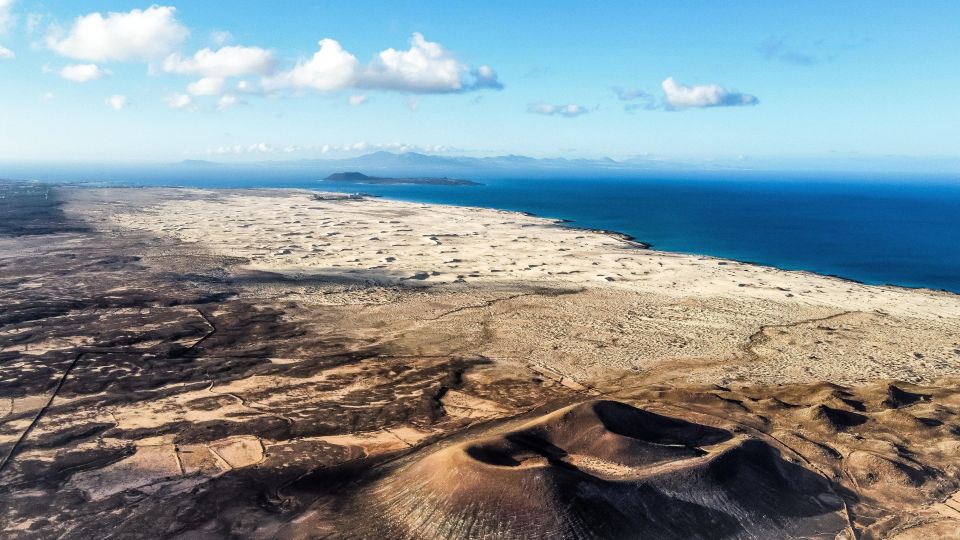
Some excursions solve the transport problem themselves. The “Wild North and Corralejo” tour explicitly starts in Morro Jable and Costa Calma, lasts 7 hours and costs €77 — for anyone without a car that is the only realistic way to see the north from the southern tip. The itinerary covers Popcorn Beach, El Cotillo and a volcanic crater, plus free time in Corralejo.
Check availability and prices for “Wild North and Corralejo”
The catch: on Fuerteventura, roughly one in ten offers even mentions pick-up in its description, and the pick-up zones are always limited. An operator writing “hotel pick-up in Jandía” rarely means every property in Jandía. If your hotel is not on the list you will be sent to a meeting point, which might be two streets away or in the next resort. Check the stated zone before booking and have the pick-up address confirmed. Do not assume it can be sorted out afterwards.
What is realistically a guided tour only
Cofete is the clearest case. The beach lies 130 kilometres from Corralejo, a good 2 hours 25 by car, because the last stretch is a dirt track over the Jandía ridge. There is in fact a bus: line 111 runs from Morro Jable via Cofete to Punta de Jandía, twice a day, for around €8.70. It leaves Morro Jable at 10 am and 2:15 pm; at the lighthouse the bus turns round after a short stop and heads back at 12:15 pm and 4:15 pm, passing Cofete at roughly 1 pm and 5 pm according to the operator. Those two return times shape the whole day. You cannot reserve a seat, and when the bus is full it does not stop en route. Miss the return and you are sitting on a beach with no village behind it.
That is why most people buy the drive instead. The jeep safari to Cofete costs €65 for 3 hours, the version taking in Villa Winter €57 for 4 hours.
See dates for the jeep safari to Cofete beach
Lanzarote, by contrast, is easy enough to reach on your own — the Corralejo–Playa Blanca ferry takes around 25 minutes and runs very frequently — but you arrive at the port with no way of moving on. That second problem is exactly what the Lanzarote day trip with lunch solves: ferry, bus, Timanfaya National Park, the Jameos del Agua lava tunnel and a winery, with entry fees and lunch included, for €160. Allow for 15 hours door to door — that is a whole holiday day, not an excursion.
Where being car-free really bites
The west coast. Ajuy and its caves are effectively not reachable by bus at all: the village appears exactly once in Tiadhe’s route listing, as an early weekday departure on line 18 from Ajuy to Gran Tarajal. No service in the opposite direction appears anywhere in the timetable. Betancuria sits on line 2, whose Sunday service finishes in the afternoon. The empty beaches between El Cotillo and the north-west coast have no stop at all.
Evenings are the second weak point. Line 8 runs to El Cotillo into the evening hours, and its timetable is the same every day of the week: the last departure from Corralejo is at 10 pm and the last one back from El Cotillo at 11 pm. What is thin on the ground is the direct runs that skip La Oliva. Sunset at El Cotillo harbour is easy to plan, and so is dinner afterwards — as long as you keep that 11 pm bus in mind.
Then there is spontaneity. If the wind suddenly drops on the Sotavento side and you would rather be in the north, that is an hour by car and a lost day without one. Anyone wanting to chase the wind for surfing or windsurfing is effectively planning around a vehicle.
When a hire car is the better decision
From roughly three planned excursions a week onwards, the car comes out cheaper than the sum of tours and taxis, and all the more so for four of you: the bus charges per head, the car does not. The same applies if you are staying outside the four big resorts, moving equipment around, set on seeing the west coast, or travelling with small children on fixed routines where one missed connection ruins the evening. There is more on how journey times shape a family day in the article on half-day versus full-day tours.
Without a car you are in good shape if your holiday consists of the beach, two or three booked excursions and Lobos. The overview of what to see in Fuerteventura sorts out which destinations are worth it, and the list of family-friendly beaches covers the ones within walking distance. For using the bus with a pushchair or with reduced mobility, the details are in Fuerteventura with a pushchair and with limited mobility. We deliberately make no claims about the accessibility of individual buses; that is something to ask the operator.
Our recommendation
For most people without a car: the Lobos ferry from Corralejo for €17. It leaves right from the middle of town, so there is no transfer and no fixed return time to plan around, and with 3,521 reviews at 4.7 stars it is the most reviewed Lobos crossing. Anyone not staying in Corralejo does, though, first have the bus ride there ahead of them — from Morro Jable that is not a day-trip idea.
Anyone staying in the south: dolphin and whale watching from Morro Jable for €49. Two hours, the harbour is at the edge of town, and drinks and a swim stop are included. The 4.2 stars are no accident: wildlife cannot be ordered to appear, and anyone expecting a dolphin guarantee will be disappointed.
Anyone wanting to see the north from the southern tip: “Wild North and Corralejo” for €77. Seven hours from Morro Jable or Costa Calma, and without a car there is no alternative. With small children it is too long.
For Cofete: the jeep safari to Cofete beach for €65. Three hours instead of a day that hangs on two bus departures. Cofete is not a swimming beach, and the tour does not change that.
Anyone wanting to compare further will find the rest of the trips under things to do in Fuerteventura and Isla de Lobos.