Half day or full day: which trip length actually works with kids on Fuerteventura
Updated September 6, 2026 · 7 min read

Seven hours for €77, three hours for €65. Put those two lines side by side and the decision seems to make itself: the full day looks twice as good a deal. With children it almost never is, and the reason isn’t printed on the listing. It’s on the map.
Price per hour rewards exactly the wrong tour
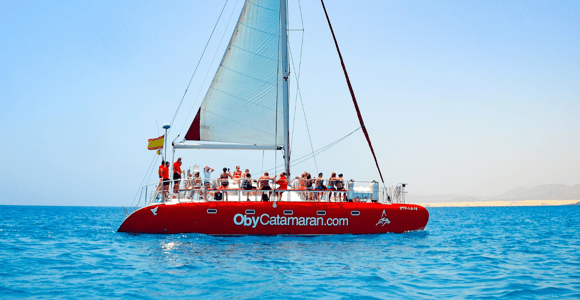
Do the sums on the island’s best-known trips. Dolphin and whale watching out of Morro Jable costs €49 for 2 hours, so €24.50 an hour. The jeep safari to Cofete beach: €65 for 3 hours, around €21.70. The buggy safari from Corralejo: €60 for 3 hours, an even €20. A catamaran trip with food and drinks: €79 for 4 hours, just under €20. The glass-bottom boat: €75 for 4 hours, below €19.
Then the long ones. Timanfaya and southern Lanzarote, 7 hours, €83 – that’s €11.90 an hour. The wild north and Corralejo starting from the south, 7 hours, €77 – €11 an hour. Among the island’s best-known tours, that makes the full-day trips comfortably the cheapest by the hour. Across the whole catalogue several half-day offers sit lower still: the guided land excursion into the Corralejo sand dunes costs €20 for 5 hours, which is €4 an hour.
That’s the trap. Price per hour assumes every hour is worth the same. For adults that roughly holds. For an eight-year-old, hour seven isn’t worth less than hour one, it’s worth less than nothing: it costs you the evening, and depending on how the journey back goes, the next morning as well. A figure arrived at by dividing price by duration cannot show any of that.
What lies between the resorts is the real expense
Fuerteventura is the second largest of the Canary Islands and long on its north–south axis. Corralejo to Morro Jable is 111 road kilometres, roughly 1 hour 40 by car. Costa Calma is 92 kilometres and about 1 hour 25. Cofete beach, behind Jandía on the Atlantic side, is 130 kilometres and a good 2 hours 25, because the last stretch is a dirt track.
The route runs along the FV-2, which covers the 71 kilometres from Puerto del Rosario to Morro Jable and continues north as the FV-1 to Corralejo. It is not a continuous motorway, and a coach calling at three hotel zones on the way moves slower than your hire car.
The rest is arithmetic. If you’re staying in Morro Jable or Costa Calma and want to go north, three and a half to four hours disappear into the journey alone. A three-hour experience becomes a seven-hour day. That’s why the wild north tour is explicitly sold as “from the south” and listed at 7 hours: the island itself is the surcharge.
Stay nearby and everything shrinks again. Corralejo to El Cotillo is 20 kilometres and a good 20 minutes; the edge of the dune park is 3.3 kilometres and six minutes away. Caleta de Fuste to Corralejo is roughly 45 to 50 kilometres and about 40 minutes, and Puerto del Rosario is next door. Base yourself in the middle of the east coast and you can reach more places in half a day than any other family here. Without a hire car it looks different: bus line 10 takes around 92 minutes between Puerto del Rosario and Morro Jable with 28 stops, and Corralejo to Morro Jable with a change works out at roughly three and three-quarter hours.
The catalogue already thinks in half days
Count the durations across things to do on Fuerteventura and the picture is unambiguous. Three hours is the most common length with 29 offers, followed by 4 hours with 22, 2 hours with 19 and 5 hours with 14. Only then come the long formats: 8 hours eight times, 7 hours six times, 6 hours five times, 9 hours three times. At the short end sit 1 hour six times and 1.5 hours four times.
Anyone who treats the half day as the family compromise hasn’t looked at that spread. Here the half day is the norm and the full day is the exception.
Two windows in the day nobody enjoys being outside
The afternoon is not the relaxed half of the day on this island. In Corralejo, from April to September, the trade wind follows a dependable daily rhythm: between seven and nine in the morning it blows lightly at eight to twelve knots, from nine to eleven it builds to twelve to eighteen, from eleven to two it sits at eighteen to twenty-four, and between two and five in the afternoon comes the daily peak at eighteen to twenty-six knots. Only after five does it ease off. That is exactly why the sails are out along the north coast in the afternoon – and exactly why a towel there at the same hour is no fun at all.
Add to that the early afternoon as the hottest part of the day, and the fact that outside the towns Fuerteventura offers almost no natural shade. A tour that stops for photographs at two o’clock at the windiest point on the island reads like a highlight on paper. As a family you’d rather be back by then, by three or four at the latest, so the afternoon ends at a sheltered hotel pool or on a calm beach rather than on a coach.
Fifteen minutes is not a tour, it’s a crossing
The special case sits right at the bottom of the duration list. Getting to Isla de Lobos is a quarter of an hour out of Corralejo by speedboat, €16 there and back; the ferry charges €17. That isn’t an excursion with a programme, it’s a ticket across a stretch of water.
In planning terms the difference is enormous: on a tour the operator decides when you come back, on a crossing you do. You can return after two hours and you can stay. The nature park does require a free permit, applied for at lobospass.com. It is issued for two slots split at 2 pm, the first opening at 10 am and the second closing at 6 pm, capped at 200 people on the island at once. Whether your operator handles it varies from one to the next, and the conditions get adjusted from time to time — ask before you book. If you have a child who has had enough after ninety minutes, Lobos is the one place on this island with an emergency exit.
When the full day is right anyway
Sometimes the journey isn’t the price of the destination, it’s part of it – and sometimes the approach alone eats the half-day format. Lanzarote is both: ferry, coach, Timanfaya, coach, ferry, 7 hours, €83. A child who has never stood on a ferry counts the crossing, and there is no shorter way to reach the neighbouring island from here. Cofete is similar, where the drive over the pass beats the stop at the end: 4 hours for €57.
What a day like that demands isn’t written on a birth certificate: being able to occupy yourself, tolerating long stretches of nothing, not feeling ill in a moving vehicle. In the catalogue, only the Can-Am buggy experience from Costa Calma states a minimum age in years: from 7. The jet ski in Caleta de Fuste is 18 and over, and two catamarans are adults only. Everything else is on the individual booking page, and what applies on the water is covered in boat trips with children.
When a full day is a bad idea
On arrival day and departure day. On the first day after a night flight. On any day when a nap is still part of the schedule – see Fuerteventura with a toddler. When you’re staying in the south and the destination is in the north and nobody in the family fancies two hours on a coach. And whenever the tour falls across the hours your children normally eat: a four-hour block over midday without a fixed break goes wrong more often than the same block in the morning.
The counter-calculation, done honestly
Two half days usually cost more. The jeep safari to Cofete at €65 plus the guided stargazing at the Calderón Hondo volcano at €45, 3 hours in the evening, comes to €110 instead of the €77 for the northern day. That’s about €33 extra per person, so a good €130 for four – for the wider scale, see the week’s budget.
Sometimes the sign flips, though. Two hours of dolphin watching at €49 plus the Lobos ferry at €17 comes to €66, less than the single seven-hour day.
The real stake is a different one anyway: two half-day tours use up two mornings of a week in which three to four excursion days are realistic. In exchange you keep two whole afternoons, and neither day ends with a child who ran out of patience three hours ago. How that spreads across a full week is set out in Fuerteventura with kids.