Fuerteventura with teenagers: wind, engines, night sky
Updated October 14, 2026 · 7 min read
With small children you ask before every outing whether it will run too long. From about thirteen the question turns around: will they be bored? Fuerteventura fails that test at first glance. No density of water parks the way Tenerife has them, no big city, and certainly no nightlife in the Mallorca sense. And yet the island is one of the strongest destinations for a fifteen-year-old, because three things are normal here that adults elsewhere will not join in with: riding the wind, putting an engine on a dirt track, and driving out at night to look up.
The wind is the argument, not the flaw
What drives families with toddlers to despair is, from thirteen onwards, the reason to come. How the trade wind takes apart a day with small children is covered under Fuerteventura with kids. Here the same wind counts as equipment.
There are 19 surf lessons in the range, from €50, with a median of €54.15. The spread is strikingly tight: the beginner course here is a standardised product. Four euros separate the cheapest offer from the middle one, so you are choosing a place and a school, not a price.
With windsurfing and kitesurfing it works the other way round: 13 offers, from €63.75, median €130. That makes it the most expensive category in the whole range, dearer than any catamaran trip with its median of €79. The reason for the gap: the €63.75 belongs to a windsurfing taster course in the bay of Costa Calma, while the median belongs to kitesurfing courses. Kiting is taught in small groups of up to three or one to one, with radio contact and a safety boat. Budget one line for “surf lesson” at €50 and kiting will put you out by a factor of three.
Mornings are calm, the wind freshens in the afternoon, which is why surf lessons usually sit before noon and wind courses after it. April to August blows hardest, July hardest of all. Between October and March there are windless days, and then it is the kite lesson that gets cancelled rather than the surf lesson.
Where people learn, and where they do not
El Cotillo in the north-west is the classic place to learn: pale sand, a beach break, several sections side by side that suit different levels. North and west of it lie reefs over lava, and those are a different sport.
Flag Beach near Corralejo is the second big beginner beach, long sand, dependably small waves in summer, and most of the schools are based there. Playa del Moro, further south in the same dune park, picks up less swell and is the quieter spot for a second or third lesson. Majanicho on the north coast, by contrast, breaks over lava and looks more harmless at small size than it is. In the south, schools teach at Playa de la Pared, where considerably more wave energy arrives.
The wind has a territory of its own in the south. Playa de Sotavento between Costa Calma and Risco del Paso is one of the best-known wind and kite spots anywhere; World Cup events in windsurfing and kitesurfing are held here. Beginners still do not belong in the same place as the professionals. The lagoon at Risco del Paso, roughly ten minutes by car south of Costa Calma, fills with the tide and then stands waist-deep – exactly what somebody needs the first time they stand on a board. The centres usually separate the two physically as well: windsurfing and SUP off the beach at Costa Calma, kiting mostly at the lagoon.
The lagoon does not stand every day, though; it depends on tides and the phase of the moon. And a beach that looks broad, flat and harmless is often the windiest one on this island.
Jet ski and the question of age
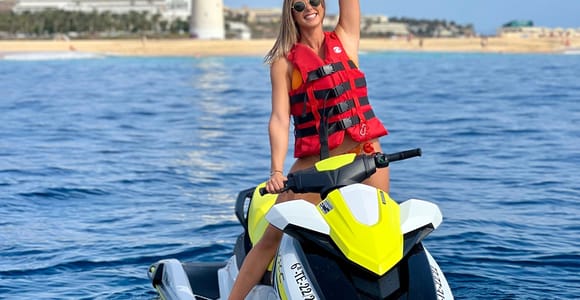
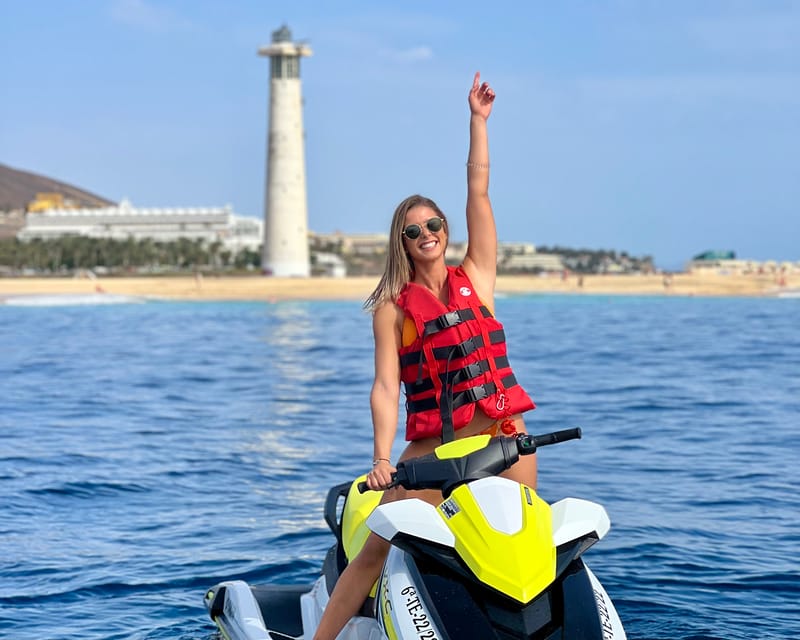
From Morro Jable the jet ski trip costs €80 for 30 minutes, no licence required, 4.7 stars from 968 reviews. That is the most expensive half hour of the holiday, and it will be asked for a second time.
More important than the price is the age. Of 190 offers, four name an age limit: the jet ski circuit at Caleta de Fuste (over 18 with an ID), the Can-Am buggy experience from Costa Calma (a four-seater, minimum age 7) and two catamaran trips to Lobos Island that are adults only. Only the booking page in question is binding. So on the jet ski at Caleta de Fuste a sixteen-year-old stays behind, and it gets settled before you book, not on the jetty. The other jet ski offers say nothing on the subject, so ask in writing before you pay for four people and go out with three. How differently minimum ages are handled on the water is covered under boat trips with kids.
Buggy and quad: driving or being driven
With 17 offers from €60 and a median of €99, buggy and quad tours are the most interesting line in the whole programme for teenagers. They are also the one that produces the most disappointment, and the cause is always the same: who is at the wheel?
Anyone who wants to drive will as a rule need a driving licence, because the tours run in large part over public tracks and roads. So a fifteen-year-old is a passenger, and if he only finds that out at the meeting point, the day is spoilt. Exactly one offer names a minimum age: the Can-Am buggy experience from Costa Calma runs a four-seater and states 7 years. The other 16 buggy offers say nothing on the subject, and operators set their limits differently, differently for passengers than for drivers; only the booking page is binding.
The buggy safari from Corralejo costs €60 for 3 hours and has 4.6 stars from 1,455 reviews; the dune buggy tour in the north is €129 for 2 hours; the tour through the Jandía nature park and El Puertito is €140 for 2 hours at 4.2 stars. Check before you click whether the amount is per vehicle or per person. And reckon with dust: buggies travel in convoy, and the last vehicle gets everyone else’s.
What there is in the evening
Corralejo has the most. Music Square on Plaza Félix Estévez is an open square with terraces and live bands most evenings; around eleven it quietens down. Add the lanes of the old town by the old harbour and the bars on Calle Iglesia. This is a square being used, not a club strip.
Morro Jable is quieter, but it has cocktail bars along Avenida del Saladar and, at weekends, a few addresses where the dancing goes on later. Costa Calma is the quietest of the three. For a sixteen-year-old who does not surf, three evenings in Costa Calma are very long.
Between Corralejo and Morro Jable lie some 111 road kilometres and a good hour and a half of driving, so that is not an evening out; from Costa Calma to Morro Jable, on the other hand, it is around twenty minutes. None of this turns Fuerteventura into a party island, and if your child is looking for exactly that, this is the wrong place. What the island offers away from the resorts is covered under what to see in Fuerteventura.
The sky as a fixture
The guided stargazing tour at the Calderón Hondo volcano costs €45 for 3 hours and stands at 4.8 stars from 936 reviews. The hill sits near Lajares in the north, 278 metres high; the crater is about 70 metres deep, and the loop around the cone runs four to five kilometres. Barbary ground squirrels with no shyness at all patrol the crater rim. More trips on land are listed under things to do in Fuerteventura.
That the Canaries work for this comes down to dry air, little cloud and hardly any haze over the Atlantic. Fuerteventura has been certified as a Starlight Reserve since 2015, the third in the Canaries after La Palma and Teide; the certification runs to 2029.
One comparison is often drawn wrongly. La Palma has had its own light protection law since 1988, the Ley del Cielo, which regulates lighting in order to protect the observatory on Roque de los Muchachos. That is La Palma, not Fuerteventura. There is no such law here, the island is flat, and its towns spill their light far across the plain. So you drive out to look, towards Lajares, out to the dunes or over to the empty west coast. Which Canary Island stands for what is the subject of the guide to what to see in the Canary Islands.
A full moon wipes out the Milky Way; if you want to see it, pick the days around new moon. And on the crater rim it is noticeably cooler and windier after sunset than down in town, August included.