Fuerteventura in a wheelchair: what is documented – and what you have to ask for yourself
Updated October 14, 2026 · 7 min read
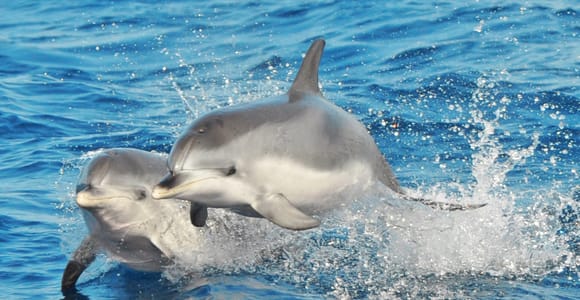
No single excursion on this island is labelled wheelchair-accessible: none of the 181 short descriptions says anything about it, neither yes nor no. Of the bookable trips, the dolphin and whale watching trip from Morro Jable at €49 hands over the least amount of time – two hours instead of the four of a catamaran day – and on this question that is half the answer. The other half is boarding, and only the operator can describe that to you. What follows is what is verifiably built on the island, municipality by municipality, and which question forces a usable answer out of which type of vehicle.
Check availability for the dolphin and whale watching trip
The full offer page can have a “not suitable for” field; you read that there yourself. That is why nothing here says that a particular tour is accessible.
Five trips and the question that decides each one
| Excursion | Duration | From | Rating | Best for |
|---|---|---|---|---|
| Lobos by speedboat | 15-minute crossing | €16 | 4.8 ★ · 1,973 | people who just want the crossing and stay by the landing stage |
| Dolphin and whale watching from Morro Jable | 2 hours | €49 | 4.2 ★ · 5,248 | people who want to stay on board for two hours, not four |
| Jeep safari to Cofete beach | 3 hours | €65 | 4.5 ★ · 2,578 | people who transfer with assistance and can take the track |
| Glass Bottom Boat Cruise with lunch | 4 hours | €75 | 4.4 ★ · 1,514 | people planning a half day with food on board |
| Magic catamaran trip with food and drinks | 4 hours | €79 | 4.4 ★ · 1,710 | couples planning four hours with no way off |
The right-hand column says how much time you commit to – nothing about ramps, door widths or toilets on board. None of the five pages gives a figure for any of that, which is exactly why what follows is questions, not promises.
Walkways and amphibious chairs: what the Cabildo installed
According to the Cabildo de Fuerteventura, pasarelas – wooden walkways over the sand – along with amphibious chairs, water crutches and amphibious walking frames have been purchased for beaches in every municipality, named for La Caleta, La Guirra and Pozo Negro in Antigua, Grandes Playas and El Cotillo in La Oliva, Morro Jable in Pájara, Playa Blanca in Puerto del Rosario, and Gran Tarajal, Las Playitas, Tarajalejo and Giniginámar in Tuineje. The Cabildo puts the purchase at €57,849.49 and assigns it to the tourism plan “Fuerte por Naturaleza”.
That is equipment, not a promise for the day you travel: walkways are put up and taken down, and the chairs are wherever the staff happen to be. What is actually standing on your beach is something the town hall of that municipality knows.
Who pushes the chair into the water
An amphibious chair locked up beside the lifeguard tower is no use to anyone. The real question is who operates it. The town of Puerto del Rosario states that a floating chair is available free of charge all year at three of its beaches – Los Pozos, Playa Blanca and Puerto Lajas – and that the lifeguard team accompanies the bather into the sea; at the first two on the spot, at Puerto Lajas with advance notice to the municipal beach department. The hours of duty are not given, and those are exactly what decides your afternoon.
For Morro Jable, Pájara town hall lists an access walkway with a ramp, an adapted toilet, adapted showers and foot baths, amphibious chairs and shaded areas. For part of the week the municipality mentions booking by phone, otherwise free use – which days and which number is something to have confirmed there.
In Caleta de Fuste, seven kilometres south of the airport, Antigua opened a ramp at the central access to Playa de El Castillo in December 2025 for €37,000: twelve metres long, two parallel walkways of around two metres in width, with side protection and handrails, covering the two metres of height between promenade and sand. It replaces a flight of steps.
Why “equipped” does not mean “accessible”
The disability association Adivia had several of the island’s beaches surveyed in 2021 and concluded that none of them met universal accessibility. What it listed: walkways that stop short of the water, roll-out mats that buckle, toilets fitted into a corner so that the transfer only works from one side, too few disabled parking spaces and some of them blocked, too little staff trained on the amphibious chair.
The findings are a few years old and building has gone on since. As a set of questions they still work: does the walkway reach the water? Can the toilet be approached from the side you lean on? Is somebody on duty at your hour who operates the chair?
Arrival: airport, bus, hire car
For Fuerteventura airport, Aena describes the “Sin Barreras” assistance service: book at least 48 hours before scheduled departure through your airline, travel agency, the Aena website, the app or by phone, be at the airport two and a half hours beforehand and report to the meeting point no later than two hours before. Plus a sentence that is easily missed – airlines can restrict the carriage of your own wheelchair or mobility scooter. You settle that with the airline, not with the airport.
The Cabildo and the bus operator Tiadhe have announced a ramp service on five lines: line 1 Puerto del Rosario–Morro Jable and Puerto del Rosario–Gran Tarajal, line 3 Puerto del Rosario–airport–Caleta de Fuste–Las Salinas, line 6 Puerto del Rosario–Corralejo, line 8 Corralejo–El Cotillo, line 10 Puerto del Rosario–airport–Morro Jable, each with advance notice to customer service 24 to 48 hours ahead. The announcement dates from 2018; whether the routes, times and phone numbers still hold is something to check with Tiadhe before you build a trip on it.
On hire cars with hand controls or a rear ramp there is no solid information for Fuerteventura: no operator undertakes for this island that such a vehicle is waiting at the desk. Hand controls are an installation, not an accessory off the shelf – ask in writing, weeks ahead, and have the vehicle type named in the confirmation. If no written commitment comes back, the vehicle does not exist.
Flat is not level
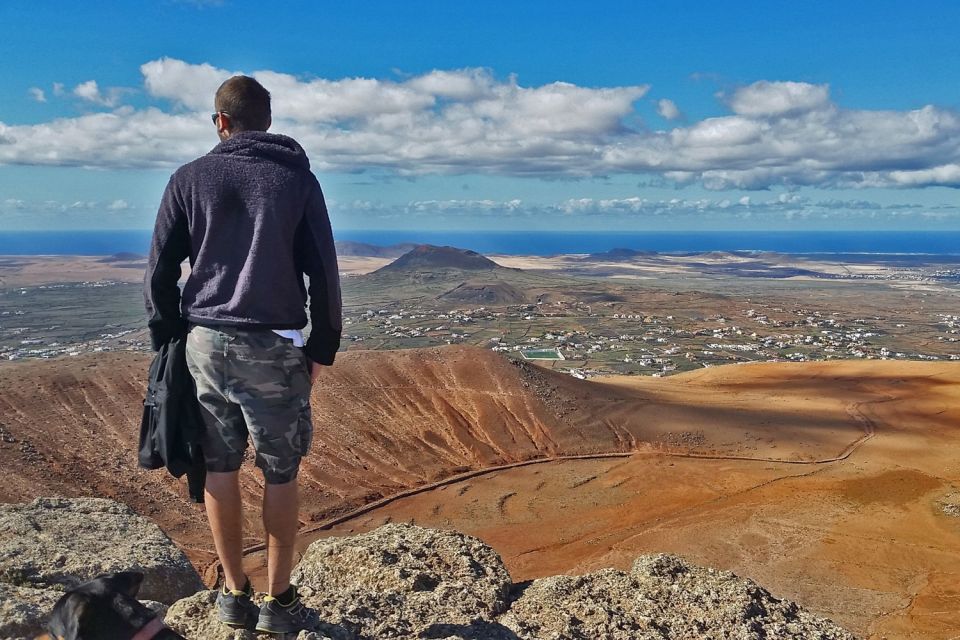
Fuerteventura has no gradients like La Palma or La Gomera, and that misleads people. The problem is the surface: loose sand, lava grit, and in the older village centres kerbs with no dropped section. From Morro Jable it is around twenty kilometres of unsurfaced track over the ridge to Cofete. It is graded several times a year, and reports from spring 2026 describe it in better condition than before, but it stays gravel with washboard and deep holes and changes within days after rain. For you that means a good hour of jolting in each direction in an unfamiliar vehicle, with nowhere to transfer and no toilet. At the far end, twelve kilometres of deep sand with no walkway, no supervision, no shade – why nobody swims there is in the piece on family-friendly beaches, the rest of the island in what to see.
The excursions: not whether, but what you ask
The offer pages lump together everything that floats; for you these are different vehicles, each with its own question.
On the short crossings to Lobos – the ferry from Corralejo at €17, the speedboat at €16 and 15 minutes – it is not the boat that decides but the point where you get aboard. Ask about a gangway or a step, a fixed quay or a floating pontoon, the tidal range at the landing at your departure time, and whether the crew is allowed to lift at all. On the island side the same question comes up a second time. All crossings: Isla de Lobos, 22 offers from €16.
Check dates and prices for the Lobos speedboat
With the Magic Catamaran Trip at €79 for four hours, boarding is not the problem – the time afterwards is. Is there a toilet on board, and will you fit through the door? Are there steps between deck and saloon? Can you change position during the trip, and is there shade? Four hours are four hours with no way out – the same goes for the Glass Bottom Boat Cruise at €75. All trips of this kind: catamaran trips, 15 offers from €62. The dolphin trip from Morro Jable runs two hours and costs €49 (whales and dolphins).
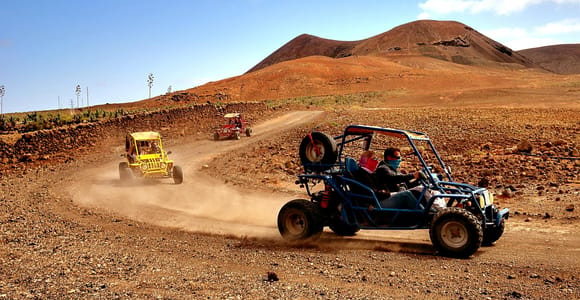
On land everything turns on the transfer. For the jeep safari to Cofete beach at €65 for three hours, or the Villa Winter run at €57 for four hours, ask about the height of the step up, where the wheelchair goes, whether it is a bench or a single seat with a back, and whether there is a stop on the way. With a buggy from €60, median €109, you drive yourself: does the operator have a vehicle without foot controls? An evasive answer is a no.
Check dates for the jeep safari to Cofete beach
Two questions belong to every booking. Is a companion required, and what do they pay? And are you talking to the operator who runs the boat, or to a platform? Ask for a photo of the boarding point; whoever has one sends it. The price range from €12.50 upwards is under things to do on Fuerteventura, how a week adds up in the weekly costs.
Isla de Lobos: four hours that are fixed
Access is regulated: a free permit issued in your name, applied for at lobospass.com. It covers either the morning from 10am to 2pm or the afternoon from 2pm to 6pm, and no more than 200 people may be on the island at the same time. Applications open up to five days beforehand, for a maximum of three people. Whether your operator handles that is something to ask – plenty do not, and the provisions change.
For you the number behind the rule is what counts: your slot lasts four hours. Lobos has no road, no shop and almost no shade, the paths are sand and lava grit, and there is no vehicle to collect you. Anyone who wants to come back earlier has to have settled that with the skipper beforehand. Where the island sits within the rest of the archipelago is in the regional overview.
When it is a bad idea
The Cofete track on a day with rain forecast. A four-hour trip when the toilet question on board has not been answered in writing. A boat booked at short notice through a chat where nobody knows the landing stage. The open west coast beaches around La Pared: no town names a walkway or an amphibious chair there, and while Pájara has listed La Pared as a surveillance zone since 2025, it gives neither hours nor months – without written information from the town hall of Pájara, plan for the beach being unsupervised. And a beach day at an hour with nobody on duty – no flag on the mast here usually means not a calm sea but no supervision at all.
Los Molinos expressly does not belong on that list: the town of Puerto del Rosario counts it among its supervised beaches, a lifeguard tower has stood there since August 2024, and with the new contract from April 2026 the town is extending the staffing from four to eight months a year. Which months those are and at what hours someone is there is something to have confirmed beforehand by the town hall of Puerto del Rosario. The town names neither a walkway nor an amphibious chair for Los Molinos.
How to ask so that you get an answer
In writing, not only by phone, and with your own figures: the width and weight of your wheelchair, whether it is electric, whether you can take a few steps, whether you transfer by yourself. Then ask back in centimetres rather than adjectives – door width, step height, gangway width, turning space. Anyone who answers “spacious” has not measured. And repeat the question 48 hours before: the office answered you, and the crew doing the trip knows nothing about it.
Our recommendation
For most people, the shorter trip: the dolphin and whale watching trip from Morro Jable for €49. Two hours instead of four, 5,248 reviews – more than any other trip on the island – and 4.2 stars, the weakest rating in this selection. Two hours is the smallest amount of time you hand over on a boat trip here. That promises nothing on its own: ask beforehand about boarding, the tidal range at the landing, and the toilet on board, and get a photo of the boarding point.
For a small budget: Lobos by speedboat for €16. Fifteen minutes, 4.8 stars from 1,973 reviews, the shortest excursion in the whole range. Expect to stay by the landing stage on the other side: the paths are sand and volcanic grit, and the time slot runs to four hours.
For a half day with food on board: the Glass Bottom Boat Cruise for €75 or the Magic Catamaran Trip for €79. Both last four hours, both hold 4.4 stars. Book these four hours only once the toilet question has been answered in writing – otherwise they are four hours with no way out.
What we would advise against as long as nothing is confirmed in writing: the track to Cofete, three to four hours of washboard with nowhere to transfer, and the buggies, where you drive yourself. And any platform that does not pass your questions on to the crew.