The one drive on Fuerteventura that is worth it: the FV-30 to Betancuria and down to Ajuy
Updated October 1, 2026 · 9 min read

You can manage this drive in any hire car: the FV-30 over the pass to Betancuria is surfaced the whole way, one lane in each direction, and fitted with a barrier along the exposed stretches. Allow around 1 hour 20 of actual driving and four to five hours for the half day. Two things up front: Mirador Morro Velosa is temporarily closed, while Mirador de Guise y Ayose is free and has no opening hours. Anyone who would rather not drive — because lunch involves wine, or because the stay is too short for a hire car — is best served by the panoramic tour for €65: eight hours, with Ajuy and Sotavento both on the itinerary.
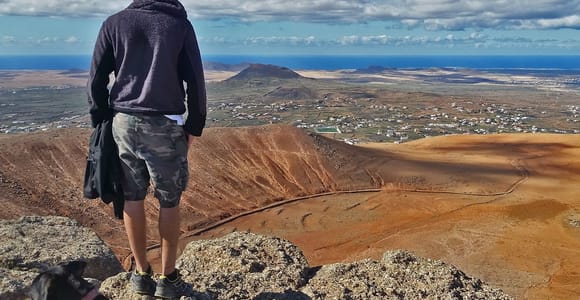
Fuerteventura has a reputation for being flat, and the reputation comes from the airport road. The FV-2 runs past the airport across a wide brown plain, and if that is all you see you will believe it. The drive described here exists to correct that in about half a day. It crosses the island’s mountain spine on a road with bends and a crash barrier, stops in a village that was the island’s capital for more than four centuries, and ends at a cliff face on the west coast where the rock is 40 metres high and the Atlantic is doing something the east coast never does.
It is one route, not a list. That is deliberate — an itinerary with nine stops is a list of places you will drive past.
The route, in driving time rather than kilometres
From Caleta de Fuste or Puerto del Rosario you head inland on the FV-20 towards Antigua, then pick up the FV-30, which climbs over the pass and drops into Betancuria. From Betancuria the same road carries on south through Vega de Río Palmas to Pájara, and at Pájara you turn onto the FV-621 for the last 10 kilometres down to Ajuy on the coast.
End to end, allow around 1 hour 20 of actual driving for the Betancuria-to-Ajuy stretch and its approach, and plan the day at four to five hours with the stops. From Corralejo or Morro Jable add the run down or up the main road first; from Morro Jable in particular this becomes a full day rather than a half one, and that is worth knowing before you set off after lunch.
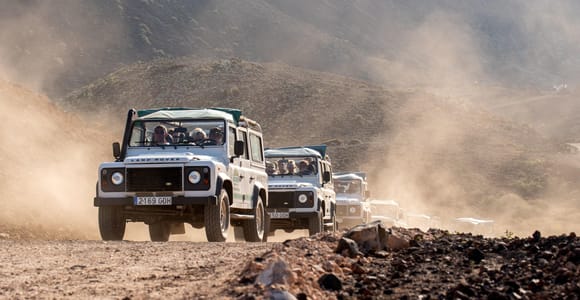
The FV-30 itself is the part people are not expecting. It is narrow in places and bendy, one lane in each direction, surfaced the whole way and fitted with a barrier along the exposed sections. Any hire car does it. It does not need a four-wheel drive, and it is not the kind of mountain road that frightens people — it is the kind that makes them stop.
The viewpoint that is closed, and the one that is not
This is the single most useful thing on the page, so it comes before the scenery.
Mirador Morro Velosa, the César Manrique viewpoint at 669 metres above Betancuria, is listed by the island’s own museum network as temporarily closed. Its published hours when open are Tuesday to Saturday, 10 a.m. to 4 p.m., with free entry. Do not build the day around it, and treat any tour description or blog post promising it as out of date until you have checked the museum site yourself.
Mirador de Guise y Ayose is the one to aim for instead, and it is arguably the better stop anyway. It sits directly on the FV-30 at the top of the pass into Betancuria, with its own parking area, free, no opening hours, no ticket. Two four-metre bronze figures stand there: Guise and Ayose, the last aboriginal kings of the island’s two territories — Maxorata in the north, Jandía in the south — before the European conquest in 1402. The view north takes in the eroded hills; the view south runs down the barranco towards Betancuria. It fills up in the middle of the day in summer and empties again quickly, because nobody stays long.
Compare hire cars for Fuerteventura
Betancuria: the capital with no coastline
Betancuria was founded in 1404 and served as the island’s capital until 1834. It was built inland, in a valley ringed by hills, for a reason that is still visible in its position: distance from the sea was distance from the raids. On an island whose whole tourist economy now sits on the coast, an old capital that deliberately turned its back on the water is a genuinely strange thing to stand in.
It is small. The church, a few streets, a handful of restaurants and craft shops, and a car park that is adequate on a weekday and not on a Sunday. An hour covers it comfortably, two if you eat. We put it in context with the rest of the island in what to see in Fuerteventura.
One practical note: this is the stretch where a coach tour and a hire car diverge most. The coaches stop here, and they stop together, and between roughly 11 a.m. and 1 p.m. the village holds several of them at once. Arriving before or after that window is the single biggest thing a car gives you on this route.
Ajuy: the oldest rock in the Canaries, and a steep set of steps
Ajuy is a small fishing village on the west coast with a black-sand beach, a few fish restaurants and a car park that is fine early and full at midday. The village is the reason most people come, but the reason it is protected is behind it.
The Monumento Natural de Ajuy was declared in 1987, covers 31.8 hectares, and sits inside the larger Parque Rural de Betancuria. The cliffs here reach around 40 metres. What is exposed in them, according to the island’s tourism authority, is the oldest rock in the Canary Islands: sedimentary layers laid down on a deep ocean floor between 100 and 150 million years ago, in the Cretaceous, long before any of these islands existed above water. Cut into the cliff face are old lime kilns, where limestone was burned into quicklime for whitewashing houses and for mortar; they are not a reconstruction, they are what is left of an industry.
Access is a stone ramp at the far end of the beach, then a cliff path with steps. It is steep, the surface is uneven, and the drop is real. Wear something with a sole. If your group includes anyone unsteady on stairs, the beach and the headland above it are the honest limit — and that is not a wasted stop, because the view of the cave mouths from the path before the descent is most of the picture. We cover the wider question of what works and what does not in Fuerteventura with limited mobility.
This is not a swimming day. The west coast here is open Atlantic, the beach is dark sand and the water behaves nothing like the sheltered east-coast bays. If the family wants to get in the sea, plan it for a different day and a different coast — the family beaches are all on the other side of the island.
Summer against winter
The same route is two different days depending on the month. In winter, after rain, the barrancos around Vega de Río Palmas turn genuinely green and the low sun picks out the terracing on the hillsides; it also gets dark early, so a late start means driving the FV-30 in the dark on the way home, which is doable but not what you came for. In summer the interior is at its most washed-out in the middle of the day, the miradors are busiest, and the light is worth having only in the first and last two hours. Our month-by-month guide goes through the pattern.
Either way, the interior is cooler and windier than the coast you left. A fleece in the car is not an overreaction at a 669-metre pass.
When the guided tour is the better buy
Three cases, and we would say the same thing to a friend.
If lunch involves wine. Spain’s drink-driving limits are strict and the FV-30 is not a road to be casual on. A guided island tour solves this properly.
If you want the food and the farms rather than the viewpoints. The tapas and local-life tours go into places a self-drive day does not reach — cheesemakers, an oil press, roadside produce — and those are relationships a guide has and you do not.
If you are here for two or three days. The setup cost of a hire car, the desk, the fuel and the return, all compress badly into a short stay. Whether to hire at all is the question to settle first.
Four tours cover these cases. All four go into the interior and along the west coast, and none of them depends on Mirador Morro Velosa.
| Tour | Duration | From | Rating | Best for |
|---|---|---|---|---|
| Panoramic tour of the island | 8 hours | €65 | 4.7 ★ · 583 | anyone who wants Ajuy, Sotavento and the dunes in one day without driving |
| Tapas and local life | 5 hours | €78 | 4.9 ★ · 472 | couples who want to eat and drink rather than tick off viewpoints |
| Hike to the Ajuy caves and the Arco de Las Penitas | 7 hours | €80.75 | 4.9 ★ · 80 | good walkers who want more than the cliff path |
| Making goat’s cheese at a farm | 2.5 hours | €75 | 5 ★ · 127 | families with children who do not want to spend a whole day on a coach |
Check availability and prices for the panoramic tour
The tapas and local-life tour lasts five hours and costs €78. The programme includes tasting cactus fruit, mojo sauces and jams, an oil press and Majorero goat’s cheese. That is exactly the side of the island a drive over the pass does not take in.
Check dates for the tapas and local-life tour
Anyone after something shorter takes the cheese farm: two and a half hours for €75, milking Majorera goats, making fresh cheese yourself, a Canarian breakfast, and you take your own cheese home. More trips into the interior are under things to do in Fuerteventura.
Check dates for the goat’s cheese farm
One thing this route is not
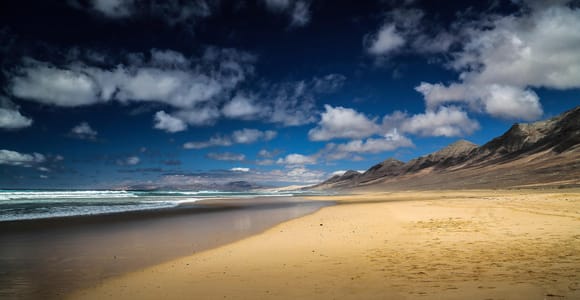
It does not continue to Cofete. That is a separate proposition with an unpaved track over the Jandía ridge, and driving off asphalt is forbidden outright in many rental contracts on this island — we set out the wording in excess, deposit and what the desk adds. If Cofete is on your list, it belongs on a different day and in somebody else’s vehicle.
The Betancuria loop needs nothing more than the car you already rented, a half tank and a start before the coaches.
Our recommendation
For most people: drive it yourself. The route is the whole point of this page. Half a day, no fixed times, and you are in Betancuria ahead of the coaches — no guided tour can give you that. Check prices and conditions for Fuerteventura.
Anyone who would rather not drive, or cannot: the panoramic tour for €65. Of the guided trips with Ajuy on the itinerary, it is the cheapest, and with 583 reviews at 4.7 stars the best documented. The trade-off is eight hours on a fixed schedule, and the viewpoint you care about most does not necessarily feature.
For couples who want to eat: tapas and local life for €78. Five hours, and nobody has to skip the wine. Scenery is incidental here — anyone wanting to see the Ajuy cliffs is in the wrong place.
For families with younger children: the goat’s cheese farm for €75. Two and a half hours, animals, something to do, and the day is not over afterwards. It has nothing to do with the route over the pass, though.