Fuerteventura with kids in bad weather: the day that is almost never a rainy one
Updated October 1, 2026 · 9 min read
The rainy day you plan for almost never comes: 15.7 days a year with at least one millimetre of rain, and between June and August practically none at all. What actually wrecks a family day here is wind, Saharan dust and swell — and all three show a sun icon in the weather app. There is not much under a roof, and the best of it is cheap: the combined ticket for the salt, cheese and windmill museums costs €12.50 and covers three sites you can drive to yourself. For a dusty day without rain, Oasis Wildlife for €41.50 is the obvious answer, though it is the wrong one in real rain: it is an open-air site.
Four excursions for the day that does not happen at the beach
| Excursion | Duration | From | Rating | Best for |
|---|---|---|---|---|
| Combined ticket: salt, cheese and windmill museums | Entry ticket | €12.50 | 4.5 ★ · 163 | families with their own car, three stops spread across the day |
| Acua Water Park in Corralejo | Entry ticket | €30 | 4.3 ★ · 878 | children whose beach morning the wind has ruined |
| Oasis Wildlife near La Lajita | Entry ticket | €41.50 | 4.6 ★ · 3,699 | families on a calima day — not in the rain |
| Surf lesson for kids and families | 3.5 hours | €54.15 | 4.8 ★ · 56 | older children for whom the windy day is the best of the week |
Anyone hunting for a rainy-day plan before the trip is preparing for the wrong problem. The airport records an average of 98 millimetres of rain a year, spread across 15.7 days with at least one millimetre – the climate normals published by the Spanish weather service AEMET for 1981 to 2010. Between June and August the table sits at practically zero. The days that genuinely break a family day here show a sun icon in the weather app.
The windy day is the most common one
It has no warning colour, just a number next to the sun, and that number decides whether the morning at the beach happens. What drifting sand at knee height does to a two-year-old is set out under Fuerteventura with a baby and Fuerteventura with a toddler. What counts here is the consequence: a strong trade-wind day costs you the beach with small children, but not the day.
For older children the sign flips. This wind is the reason so many schools are based here: surf lessons start at €50, with a median price of €54.08, and windsurfing and kitesurfing starts at €63.75, median €130. A day that has the six-year-old in tears is the twelve-year-old’s best of the week. The course offered explicitly for kids and families is priced at €54.15 for three and a half hours; the instructor holds a lifeguard licence.
Check availability for the surf lesson for kids and families
Younger siblings are better off with water than sand on a day like this. The Acua Water Park is in Corralejo and costs €30 — slides, a wave pool, rides.
Check dates and prices for the Acua Water Park
Calima is often there and rarely visible
Saharan dust sits over the Canaries more often than people assume, and you see almost none of it. An analysis of airport visibility readings from 1980 to 2022, produced by AEMET and the Universidad de La Laguna, arrives at a good 24 visible days a year; a single episode lasts 1.8 days on average.
They fall into two peaks, January to March and July to September, and behind them lie two quite different weather patterns. In winter the dust stays below two kilometres, its highest concentration is at ground level and the trade wind is weak – that is the ochre version, with fine sand on the balcony table, in the hire car and in the changing bag. In summer it floats in an elevated Saharan layer at around two and a half kilometres while the trade wind carries on underneath: milky light, a muted sun, but not necessarily heat.
Visibility during these episodes averages between seven and nine kilometres, while AEMET’s yellow warning level only starts below three. On 22 February 2020, 1,300 metres was measured at Butihondo in the south of the island and 48 flights were cancelled at the airport – an exceptional case: across the 42 years analysed, 46 episodes dropped below five kilometres of visibility, and only four of those reached a dust intensity index above 10.
It is reasonably predictable the day before. The WMO Barcelona Dust Regional Center, run by AEMET and the Barcelona Supercomputing Center, publishes free 72-hour dust forecasts at dust.aemet.es, and the Canary government issues a calima pre-alert island by island. How strong it will get is something AEMET itself is reluctant to forecast. Questions about dust, eyes and airways belong at the local pharmacy or with a paediatrician.
The swell day: when the boat does not sail
Swell and wind are not the same thing. It can be almost calm and still run high enough for operators to cancel the departure. You can check that the evening before through AEMET’s maritime forecast and the pre-alert for coastal phenomena.
Two cases get confused. The first: you cancel. With the vast majority of tours that is free up to 24 hours beforehand, a platform rule that has nothing to do with the weather. The second: the operator cancels because the sea will not allow it. You are then usually offered an alternative date or your money back, including on bookings that are otherwise non-refundable. What is not refunded is everything around it – the drive to Morro Jable, the hotel room, half a holiday day. What you should ask beforehand is set out under boat trips with kids; which trips are on offer at all you can see under Isla de Lobos tours.
A swell day is also the worst day for Ajuy on the west coast. The black beach faces the open Atlantic, there is no supervision, swimming is not advised there anyway, and on days with a warning in force the path to the caves has been closed before.
When it does actually rain
The rain falls almost entirely in the winter half of the year. On the same AEMET figures, twelve of the 15.7 rainy days fall between November and March, with December the wettest month at 3.2 days; June and July stand at zero.
The difference between north and south is smaller than the question suggests – the island splits more into flat and high. The island-wide average is around 140 to 150 millimetres, on the flat coastal strips barely 100. Most of it goes to the ridges of the Jandía massif in the far south, with Pico de la Zarza at 807 metres, and of the Betancuria massif in the middle of the island: 150 to 250, by some accounts up to 300 millimetres. Corralejo, Puerto del Rosario and the resorts all lie in the dry part.
And when it does rain, it is rarely all day but half an hour of it hard. The barrancos then carry water without warning and roads crossing dry channels stand under water. For the day’s plan that means: waiting beats replanning.
What there really is under a roof
Not much, and some of what is online is wrong. Fuerteventura has no public aquarium; the big Canarian aquarium is on Gran Canaria. The last cinema in Puerto del Rosario, the Odeón, closed for good in March 2025 but is still listed in directories. The Casa de los Coroneles in La Oliva has been shut for restoration since 2022.
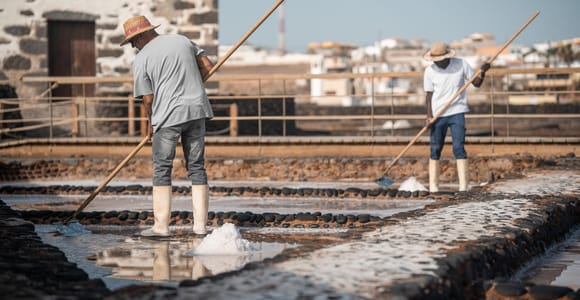
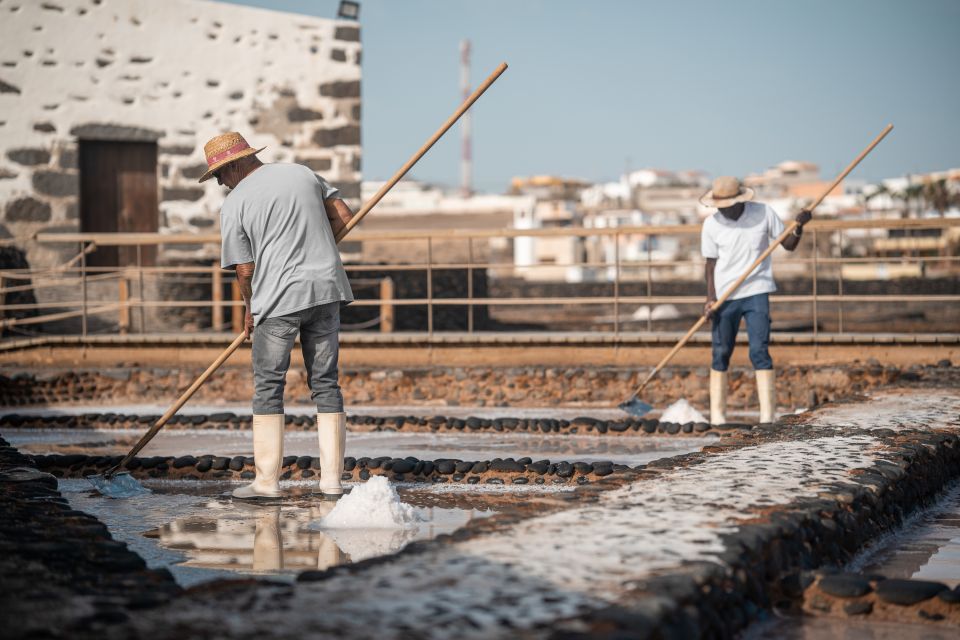
What there is: the Cabildo runs sixteen museums and visitor centres. The Museo del Queso Majorero in Antigua costs €5, and €3 for children under eleven, open daily, from 10am to 6pm in the summer half of the year and 9.30am to 5.30pm in winter; the exhibition sits indoors around a courtyard, with the mill and the cactus garden outside, and the cheese tasting costs €4 per person extra, bought at the ticket desk, daily between 10am and 1pm while supplies last. A combined ticket at €12.50 and €7.50 also covers the Museo de las Salinas del Carmen near Caleta de Fuste and the windmill centre at Tiscamanita; separately those two cost €6 and €3, and €4 and €2.50, with Tiscamanita open Tuesday to Saturday only. At the salt pans, though, the most interesting part, whale skeleton included, lies out in the open.
This combined ticket can also be bought in advance, for €12.50 per person, and then on the rainy day you have all three sites in your pocket, with the driving times between them up to you.
Check availability for the combined ticket for the three museums
Free are the Museo Arqueológico in Betancuria and the Casa Museo Unamuno in Puerto del Rosario, both indoors and both with short opening hours. The only thing genuinely underground is the Cueva del Llano near Villaverde, a 650-metre lava tube – currently listed by the Cabildo as temporarily closed, as is the Mirador de Morro Velosa. Prices and opening days change often, so check museosfuerteventura.com before setting off.
The one place that carries a rainy afternoon in full is the Centro Comercial Atlántico in Caleta de Fuste: six cinema screens, mostly Spanish dubbed versions and occasionally original versions with Spanish subtitles, plus six bowling lanes at €4 a game including shoes on Tuesdays and €6 at weekends with €1 more for the shoes. Las Rotondas in Puerto del Rosario is an enclosed, air-conditioned centre on four levels with a children’s play area. El Campanario in Corralejo, by contrast, is an open-air complex.
Oasis Wildlife near La Lajita comes top of every search: €41.50 for adults, €27.50 for children from four to eleven, and with 3,699 reviews at 4.6 stars the second most reviewed offer on the island. More than 3,000 animals live in the park, and a camel ride or a lemur experience can be added on. But it is a large open site – it works during a calima, and in the rain you get wet. More on land is listed under things to do in Fuerteventura.
Check dates and prices for Oasis Wildlife
Sometimes a day in the car is the honest answer
When the wind is up, the dust is down and no boat is sailing, what is left is the car with stops along the way. A loop through the middle of the island strings together Antigua, Tiscamanita and Betancuria: from Antigua on the FV-20 to Tiscamanita, around ten minutes, then on via Tuineje and Pájara along the FV-30 to Betancuria, more like 35 to 40 minutes, and back via the Valle de Santa Inés roundabout and the FV-416. On a calima day, of all days, the viewpoint part of it falls away.
Do the distances honestly: Corralejo to Morro Jable is about 111 road kilometres and a good hour and a half each way. A day in the car here is a whole day, not a filler, and if you are staying in the south you take the museums around Antigua rather than the cave in the north. What else lies along the way is under what to see in Fuerteventura.
Our recommendation
For most families: the combined ticket for the salt, cheese and windmill museums for €12.50. It is the cheapest thing in this article, it sits in the middle of the island around Antigua and Caleta de Fuste, and you set your own pace across the day — exactly what a half-hour downpour calls for. Without a car it gets difficult: the three sites are not strung along a single bus route. And the whale skeleton at the salt pans sits out in the open.
For a small budget with children who want to get in the water: the Acua Water Park for €30. It is in Corralejo, right in town, and solves the windy day more reliably than any museum. The 4.3 stars are the weakest rating in this selection — expect a solid water park, not a big one.
For a calima day without rain: Oasis Wildlife for €41.50. More than 3,000 animals, 4.6 stars from 3,699 reviews. In real rain it is the wrong choice, and with a two-year-old you see about a third of the grounds.
For children from around eight who like the wind: the surf lesson for kids and families for €54.15. Three and a half hours, and the ruined beach day becomes the best of the week. For younger siblings this is nothing — they stick with the water park.